
Understanding Text Broadcast Results
Text broadcast results show you exactly what happened to each message after you send it. We collect delivery status from mobile carriers like AT&T and Verizon to help you understand which messages reached their destination. Results typically appear immediately, though carriers can take up to 24 hours to send complete delivery reports.
In this article
- Understanding text broadcast results
- View broadcast details page
- View text result categories
- When am I charged?
Understanding text broadcast results
Text broadcast results fall into five main categories: delivered, failed, invalid, incomplete, and replies. Each category tells you what happened to your messages and helps you identify any issues that need attention.
Delivered messages
Delivered: The carrier confirmed they received your message and delivered it to the recipient's device. This process usually takes seconds but can take up to 24 hours if the carrier experiences technical difficulties.
Sent to carrier: We successfully sent your message to the recipient's mobile carrier, but didn't receive a delivery confirmation. Not all carriers return delivery receipts. If only a few results show "Sent to carrier," those messages likely delivered successfully. However, if you consistently see this result for specific numbers or entire broadcasts, contact our support team.
Failed messages
Failed messages didn't reach their destination. Understanding why helps you improve future delivery rates.
Phone unreachable: Several scenarios can make a phone temporarily unreachable:
- The phone is outside its cellular service area
- The phone doesn't have text messaging enabled
- The phone has a prepaid plan that's out of allotted messages
- Network failures on the carrier side
- The phone has spam filtering enabled (common with T-Mobile customers who can disable it by dialing #632# and pressing call, or AT&T customers using the Active Armor app)
- The phone number recently moved to a new carrier
- When a number moves to a new carrier, their number has to update. Until it does, texts from a platform like Text-Em-All still go to the old carrier. Send a test message every day or two to see when it clears. If it's still failing after several more days, the recipient should ask their new carrier to confirm the port completed.
Rejected for possible spam: Mobile carriers filter automated messages to prevent spam. These filters can be triggered by:
- Sending identical messages repeatedly
- Using excessive capitals, special characters, or punctuation
- Including email addresses in messages
- Listing phone numbers different from your sending number
- Using redirecting links or generic URL shorteners like bit.ly
Disallowed URL: Messages containing shortened or redirecting links are sometimes blocked by carriers. See our best practices for sending URLs.
Unsupported media: The media file you attached may be too large or not supported by the recipient's carrier.
Carrier limit exceeded: Carriers impose limits to reduce spam. AT&T has speed limits (messages per minute) while T-Mobile has volume limits (messages per day). Contact us if you see this result to discuss increasing your limits.
Rejected by handset: The recipient has blocked your text number. Ask them to remove the block through their phone settings or by contacting their carrier.
Text number unavailable: Your text number is enabled with a different platform. This happens when your number's phone plan changes providers. To fix this, complete our Letter of Authorization form and send it to support@text-em-all.com or call 877-226-3080.
Carrier rejected message: The carrier was unable to deliver your message. This can happen for a variety of reasons outside your control. Contact our support team at support@text-em-all.com or call 877-226-3080 for help resolving this issue.
Other result categories
Invalid: Phone numbers that opted out before your message was sent.
Incomplete: Numbers that weren't contacted because the system couldn't complete your broadcast (for example, if the broadcast was canceled or expired).
Opted out: Contacts who replied with an opt-out request like "STOP," "Please remove me," or "Wrong number."
Replies: Inbound text messages your contacts sent in response to your broadcast. You can respond to individuals or change their status to opted out.
View broadcast details page
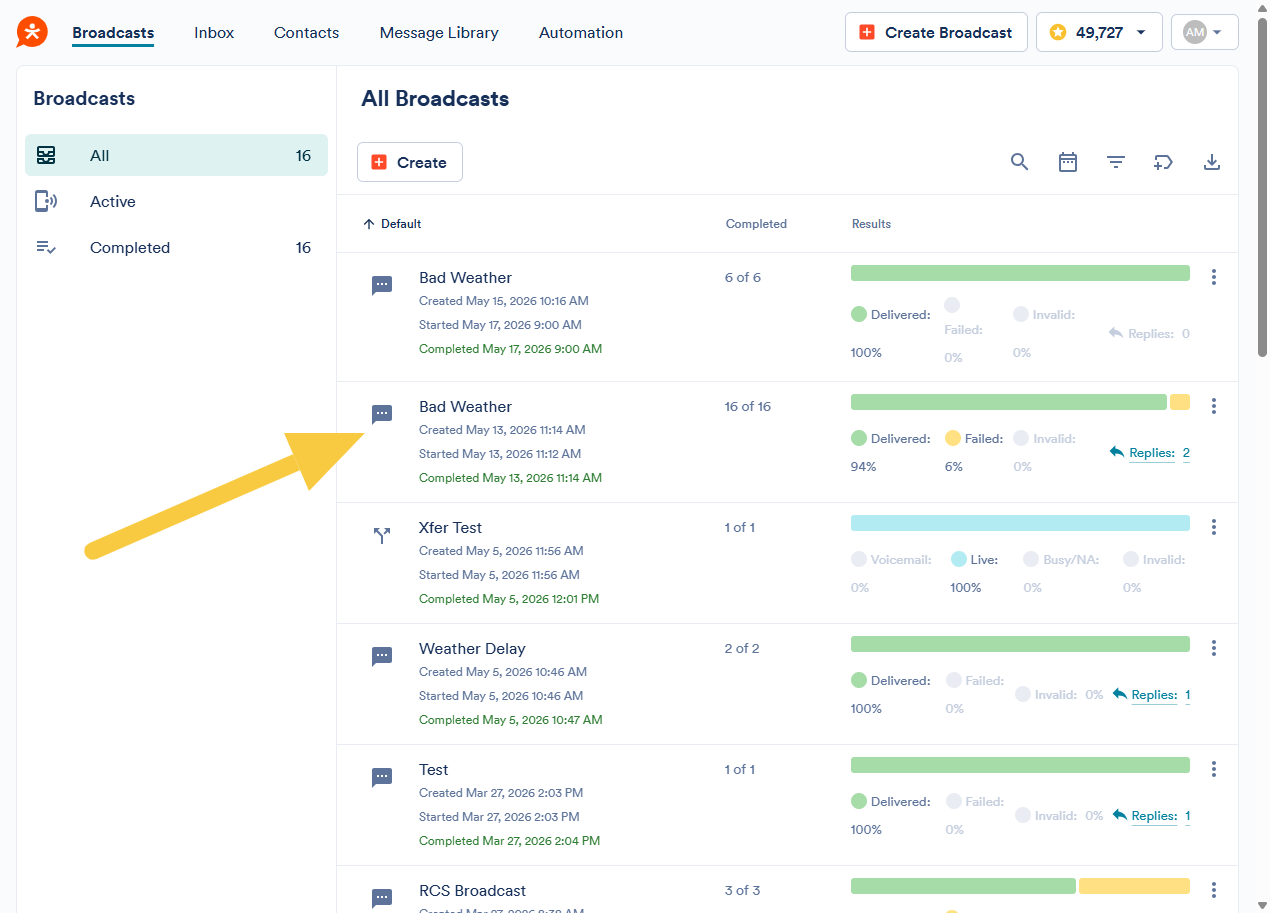
You can open detailed results for any broadcast from the Home page. This shows you exactly what happened to each message.
To view broadcast details:
- Navigate to the Home screen
- Click on the broadcast you want to review
View text result categories
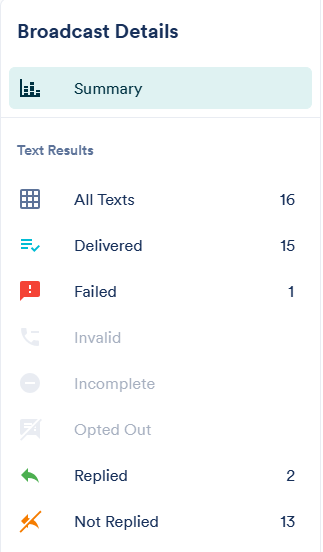
The broadcast details screen displays result categories on the left side. Each category shows the number of messages in that status.
To view specific results, click any category on the left side of your screen:
- All Texts
- Delivered
- Failed
- Invalid
- Incomplete
- Opted Out
- Replied
- Not Replied
When am I charged?
Understanding when credits are deducted helps you manage your account costs effectively. The billing rules differ slightly between plan types.
Credit-based plans: Credits are deducted only for messages sent to carriers. Messages marked "Rejected for possible spam" don't consume credits.
Monthly plans: Messages marked "Rejected for possible spam" don't count toward your group size limit.
For more information about delivery issues, see our guide on Understanding Potential Text Delivery Issues.